
Skip to Content

Composer Desktop Project: my dive into the heart of sound explorers

my dive into the heart of sound explorers
November 22, 2025 by
Composer Desktop Project: my dive into the heart of sound explorers
romainraynalpro@gmail.com
| No comments yet
We are in 2003. I am in high school, taking music as an elective, and a classmate hands me a burned CD. On it, written in marker: Aphex Twin - Drukqs. He simply says to me:
"You'll see, this guy is 'crazy'."

Composer Desktop Project :  diving into the heart of sound explorers

At that time, I was already listening to a lot of electro - Prodigy, The Chemical Brothers - but this album literally fascinated me. For the first time, I don't understand what I'm hearing. On Vordhosbn in particular, everything seems chaotic yet hypnotic. Unpredictable rhythms, psychedelic atmosphere. And back then, we didn't have the internet, just some wild urban legends.
"He is locked in a basement with his machines."
Sure, he takes drugs to make music that's so out there.
Nothing concrete. Time passes, other artists emerge, I learn new tools, and Aphex Twin remains an enigma in the back of my mind.

The Mystery CDP: Composer Desktop Project
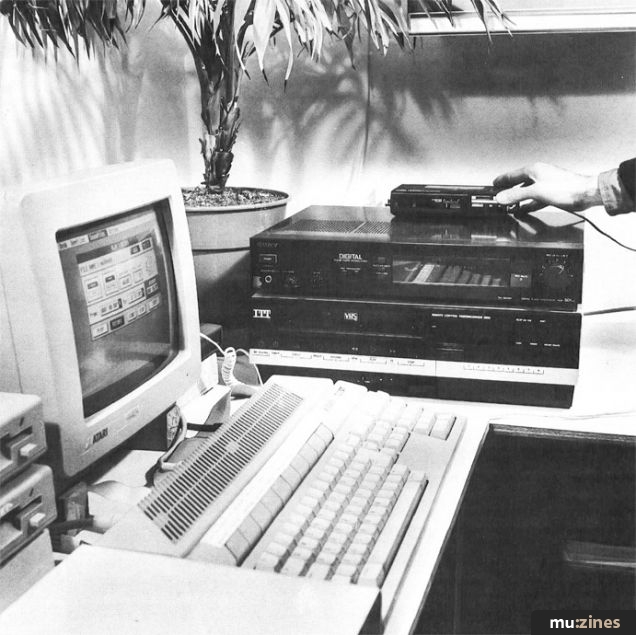
One day in 2024 - 21 years later - I come across this YouTube video by Ben Jordan. It's a fascinating dive into the tools that Richard D. James (his real name) "might have" used throughout his career. One of them intrigues me. It's CDP – Composer Desktop Project (probably used in Bucephalus Bouncing Ball). It's a suite of more than 500 audio processing tools, developed since the 80s by a collective of researchers and composers led by Trevor Wishart.  

Example of a CDP SoundStreamer system: a sound is recorded from the Sony Professional Walkman on hard disk, via the Sony PCM501 converter; the ITT VCR is used for mass storage of audio files.

Originally on Atari ST, these programs were used to explore sound in all its forms. A true sound laboratory was needed. In the photo, the CDP SoundSTreamer system allowed streaming sound from the Sony Professional Walkman through a converter: the Sony PCM501. The ITT VCR was used for audio file storage. Even today, the project is active, open-source, and completely free, accessible from any OS.


How does it work?

Historically, CDP was used via command line. No graphical interface, just lines of text to transform the sounds imported into the software. For example:  

For exemple :

pvoc anal input.wav temp.pvc 1024 256 stretch temp.pvc stretch.pvc 3.0 blur stretch.pvc blur.pvc 75 specenv blur.pvc filtered.pvc 3 0.7 pvoc synth filtered.pvc output.wav reverb output.wav final.wav 0.35 0.7


Quick decryption  :
💡
  • pvoc anal → cconversion of the signal to spectral file (.pvc)

  • stretch → prolong the duration without changing the pitch

  • blur → lisse les transitions, effet liquide

  • specenv → modifies the frequency envelope

  • pvoc synth → reconverts the spectrum into audio

  • reverb → aadd the final reverb before final render

An austere workflow, but with incredible flexibility. It's fascinating and rekindles my passion for experimental tools and for Aphex Twin and artists capable of creating music from such rigid tools. Then, I return to my modern and comfortable tools.

A modern interface: Soundthread

Good news, there is now a graphical interface for CDP. It's Soundthread, developed by Jonathan Higgins. It was David Tourdot-Fuentes (on the Game Audio France Discord) who introduced me to this tool via this videoInstallation is simple, everything is done visually. It operates with a block system, similar to Unreal’s blueprints. Effects are searchable, can be chained in series or parallel, and you can quickly experiment with hundreds of available modules. However, there is the constraint of having to generate the file to listen to the result. Nevertheless, the interface is well-designed enough that this is not too restrictive. And with our modern computers, most calculations are almost instantaneous.

First tests

I started by transforming a bell sound into an ambient texture.

Let's now test effects from a single file. So, I quickly created an audio file containing the beginning and end of one of my tracks, which I connected without really worrying about the details.

Son de base :
Let's start by testing some very simple effects.
Bit crusher :
Devider
A distortion in square waves:

Then more complex things:

Here, the file is processed by a slicer (which cuts the file into slices and replays them several times) with automations, then goes into a reverser and parallel to a reverb before combining the two output signals.

Here, the file is processed by a slicer (which cuts the file into slices and replays them several times) with automations, then goes through a reverser and simultaneously through a reverb before combining the two output signals. The result is 2:14 of sound slicing:

And yes indeed some parameters can be automated, I let you imagine the possibilities!

And yes, indeed, some parameters can also be automated. I'll let you imagine the possibilities!

Here the file is stretched by segments and then duplicated in two pitchs modify -12 and -24 before both entering a reverb: Pitched Delay.

Here, the file is stretched in segments and then duplicated into two pitch modifiers at -12 and -24 before both enter a reverb: Pitched Delay.  
An 8:22 file that is highly experimental:

The heart of the system: spectral conversion
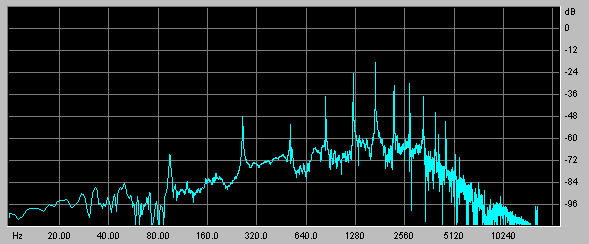
The core of the system: spectral conversion

Many CDP tools rely on spectral conversion (or spectral synthesis).

The principle:
  1. analyse a sound to transform it into a spectrum

  2. apply effects in the frequency domain

  3. reconstruct the processed sound

We can thus:
  • change the timbre without altering the pitch

  • morphing between two sounds

  • imposer le caractère d’un son à un autre

It is an approach at the intersection of music and scientific research, close to synthesis and modern granular tools. Here is what it looks like with only conversion/reconversion:
Nothing exceptional, it's the same file with more background noise. But let's try some PVOC tools to explore the possibilities.

Here we test the Stepped Freeze (a bit like a slice repeater as before) and an Average whose effect I don't know:
The Stepped Freeze with an effect called Extend Zigzag:
We're getting into the tough part with an extreme stretch and a random pitch:

A more "musical" use:

During my various tests and back-and-forths (which I unfortunately did not document), I created a piece from a train sound.
Which I then extended and ran through a bunch of effects including a resonator:
Then with pitch and time stretch effects (we're starting to have the beginning of a track)

My latest experiment

An eight-hour soundscape from a 90-second guitar sample played with a bow in 2015:

After going through the CDP mill, it results in a most peculiar one-hour file!

Finally, I processed everything in Reaper by adding saturation and reverb, and I layered it until I made a 9-hour file! Perfect for nightmares 😆


I'm taking this opportunity to announce that a compilation of ambient tracks in this vibe—entirely free and available for use (Creative Commons)—should soon be available in the section. Open Sounds of the website... 👀

Can it still be used today?

Aphex Twin in studio in early 90's

CDP is not for everyone. Its workflow is slow, experimental, and requires patience. There is something unique about CDP: exploring, learning, or creating new textures is a real adventure. But let's be honest, many of these tools now have equivalents directly integrated into our modern DAWs - in real-time. I'm thinking in particular of the brand new GRM Tools : Atelier I invite you to discover it. It is now difficult to recommend the use of CDPs today, except for those who, like me, are fascinated by music and sound (and archaeological) experiments. Soundthread revives this spirit of exploration. I encourage you to visit the Composer Desktop Project page to better understand.

Share this post
Archive

Search by datestraduis en anglaistraduis en anglais

Sign in to leave a comment
Paul Simon:
A Human and Musical Encounter | romainraynal.fr